3.1


>> power set : (2^C....)

>> Partition of [n] = {1, 2, .......n}

>> any acyclic directed graph

>> Divisors of n, or the integers by divisiblity (Z, | )
30 is least upper bound(supremum)(bound which preceeds all other uppper bounds) of 2&15
1 is greatest lower bound(infimum)(bound which exceeds all other lower bounds) of 2&15

>> vertices in a rooted tree (eg : computer directory and family tree)
students and lib are uncompairable. (similarly many things are incompairable here)

>> strongly connected components in a directed graphs
agr khi loop bn rha hai to usko ek element maan lenge.

>>


>> HASSE DIAGRAM


Lattices
(a) a ∧ b = b ∧ a (b) a ∨ b = b ∨ a
2) Associative Law:-
(a) (a ∧ b)∧ c = a ∧(b∧ c) (b) (a ∨ b) ∨ c = a ∨ (b ∨ c)
3) Absorption Law: -
(a) a ∧ ( a ∨ b) = a (b) a ∨ ( a ∧ b) = a
>>Duality: change or to and , and to or.
>>A lattice L is called a bounded lattice if it has greatest element 1 and a least element 0.
>>
Properties of Bounded Lattices:
If L is a bounded lattice, then for any element a ∈ L, we have the following identities:
- a ∨ 1 = 1
- a ∧1= a
- a ∨0=a
- a ∧0=0
- a ∧ (b ∨ c) = (a ∧ b) ∨ (a ∧ c)
- a ∨ (b ∧ c) = (a ∨ b) ∧ (a ∨ c)
- otherwise it is non-distributive lattice..
b) =f(a)∧ f(b) and f (a ∨ b) = f (a) ∨ f (b)
>>Direct Product of lattices
Example: Consider a lattice (L, ≤) as shown in fig. where L = {1, 2}. Determine the lattices (L2, ≤), where L2=L x L.
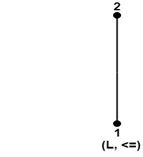
Solution: The lattice (L2, ≤) is shown in fig:
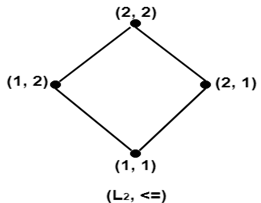
>>


Game theory
Some Basic Terms:
1. Player: individual, group of individuals or an organization
2. stategy: options available to player from which he can decide.
Pure stategy: if player chooses same stategy every time with the objective to increase gains or decrease loses. other players know what he is going to choose
mixed stategy: if player chooses combination of stategy and other players keep guessing every time the stategy he has used is called mixed stategy it is used to increase gains or reduce loses.
3.Optimum Strategy: A course of action or play which puts the player in the most preferred position, irrespective
of the strategy of his competitors, is called an optimum strategy.
4. Value of the Game: The value of the game is the “expected gain to a player” if he and his opponent use their
best strategies.
5:Pay of a matrx: nxm ka matrix hoga jisme phla column and phla row 2 players ki stategies hongi and baaki jgah gain and loss of 1'st player hai.
ye game zero sum hai mtlb jitna phla player gain yaa loss krega utna doosra player loss ya gain krega.

Usually Maximin ≤ value of the game ≤ Minimax.
If Maximin = Minimax = 0, the game is fair.
Comments
Post a Comment